What Does ‘I Confirm One’ Really Mean — And Should You Be Worried About Using It Too Much?
I confirm one is a quintessential slice of Singaporean Slang — a phrase that marches with confidence, wielding certainty like a durian in hand. But here’s the kicker: use it too often, and suddenly everyone knows you’re not just Singaporean — you’re very, unmistakably Local. Like neighbourhood uncle-local. So is it bad? Not necessarily. Is it noticeable? 100% confirm one.
TL;DR:
- I confirm one is a Singlish phrase expressing absolute certainty, often used for emphasis or to close an argument.
- It reflects core elements of Singapore’s Local Slang and Colloquial Terms, rooted in our multilingual culture.
- Overusing this Singaporean Slang may pigeonhole you as “too Local”, particularly in formal, professional, or international settings.
- It’s all about context — we’ll guide you through when to use, when to pause, and how to switch code like a pro.
- Get personal stories, practical examples, and insider tips to wield this Unique Phrase with flair (without sounding like a bao-ga-liao boss).
Origins of ‘I Confirm One’: Where Did This Phrase Come From?
Like chicken rice at a hawker stall, this phrase is uniquely Singaporean. I confirm one is an evolved version of the standard English phrase ‘I confirm it’, often used when asserting the truth of a statement. Enter Singlish — that glorious mashup of English, Malay, Tamil, Mandarin, and a whole lot of attitude — and suddenly we’ve got: I confirm one
-
Beethoven 贝多芬 T-shirt
Price range: $30.00 through $38.00 Select options This product has multiple variants. The options may be chosen on the product page

The word ‘one’ at the end? Very Singlish. Linguists call it a discourse particle — a subtle signal that you’re being dead serious. It’s used for emphasis, sealing a statement with local authority.
This Colloquial Term gained traction across races, age groups, and socioeconomic backgrounds through casual speech, secondary school conversations, and — no surprise — local TV dramas. Understanding these Cultural Terms helps you appreciate why this Unique Phrase resonates so deeply with Singaporeans.
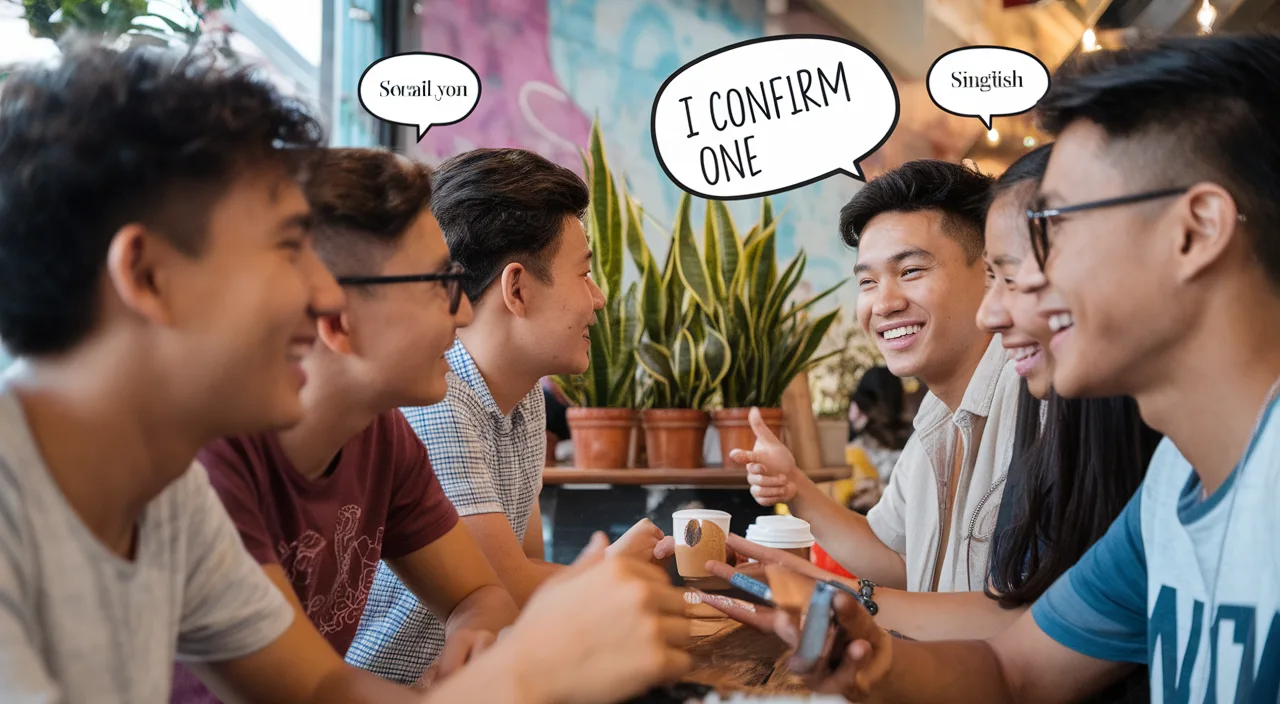
Everyday Scenarios Where ‘I Confirm One’ Shines (or Backfires)
This isn’t just a phrase; it’s a performance. You don’t say I confirm one — you deliver it with the precision of a kopi order (kosong, siu dai, plus drama).
-

#siaoliao T-shirt
Price range: $30.00 through $38.00 Select options This product has multiple variants. The options may be chosen on the product page -
OPPa T-shirt
Price range: $30.00 through $38.00 Select options This product has multiple variants. The options may be chosen on the product page


When It’s Gold:
- In Group Chats: Someone’s doubting your story? Drop an I confirm one and watch the receipt-demanding crowd stay silent.
- At Hawker Centres: Debating stall preferences? “Auntie’s prawn noodle confirm one better than the next stall.” Argument closed.
- In Office Banter: Water cooler gossip? “Eh, boss confirm one always say 5 mins but drag 30.” Relatable. Resonates. Real.
When It’s Meh (Or Worse):
- In Job Interviews: “I confirm one can handle this role.” Yikes. Doesn’t hit well outside ah-beng club.
- In Presentations: Slide 3: ‘This strategy will work, I confirm one.’ Executive board: puzzled silence.
- Meeting Your In-Laws: “Your daughter’s chicken curry confirm one not spicy.” Cannot, cannot. Tone it down, bruh.
The key takeaway? What works in a kopitiam might crash in a boardroom. You got to code-switch faster than switching from NS boy to boyfriend mode on weekends. Knowing the Singlish vs Standard English Differences is crucial for navigating these situations.
When Local Goes Too Local: The Danger of Overusing ‘I Confirm One’
Saying I confirm one once in a while? Cute. Add flavour. Take pride. But when it becomes your default — like adding chilli to everything without tasting first — you risk sounding over-flavoured. Too Local.
It becomes linguistic curry over rice: too thick, too overwhelming, and not everyone can relate. Also, watch out if you’re working with regional teams, international clients, or giving a speech at your cousin’s wedding where her angmoh husband’s entire family is in attendance.
Sometimes — just sometimes — standard English is the better laksa spoon. This is where understanding How to Use Singlish Properly becomes essential for maintaining your authenticity while staying professional.
So How To Use ‘I Confirm One’ Properly?
We hear you — you don’t want to sound fake, but also don’t want to become ah-beng general manager lah.
Let This Be Your Cheat Code:
- Use it Sparingly: Like bubble tea sugar — solid now and then, but too much equals regret.
- Context Matters: Friends’ group chat? Go wild. Monthly review report at work? Maybe skip.
- Counterbalance It: Mix with more neutral phrases like ‘definitely’, ‘absolutely’, or even just an assertive tone.
- Be Intentional: If you use it for comedic impact, great. If it’s leaking out of every sentence unintentionally, time to liddat already.

Real Talk: Times I Used ‘I Confirm One’ And It Made Things Awkward AF
Story time: I was in a regional Zoom call with partners from Japan, Korea, and Sydney. I got too hyped and blurted, “This campaign will drive traffic, I confirm one.”
*Silence.* One Korean partner typed in chat, “What means ‘confirm one’?”
-
升官發財 Boss Give Pay Raise T-shirt
Price range: $30.00 through $38.00 Select options This product has multiple variants. The options may be chosen on the product page -
Cocoda Children T-shirt
$25.00 Read more


Die. Blue tick of life.
Or that time during date night when my ex asked why I was so sure about liking Japanese food more than Korean food. “I confirm one, lah.”
She: “Okay, but you haven’t tried mine yet.” Aya. GG. Breakup pending.
These moments taught me that good language isn’t about being impressive or tribal. It’s about connection. Choose your weapon wisely when navigating between Local Slang and formal communication.
Final Thoughts: Singlish and Self-Awareness Go Hand-in-Hand
Let’s be real — we love Singlish. I confirm one is part of our linguistic DNA. It brings colour, authenticity, and often, comedic timing that standard English just can’t deliver.
But remember: language is also a mirror. It reflects where you come from, yes, but also needs to reflect where you want to go.
So whether you’re a confident Singaporean Slang slinger or someone figuring out how to balance Standard English with Local Slang, awareness — not just confidence — is key. Use it when it lifts the vibe. Tune it down when it may cloud clarity. Master these Cultural Terms and Colloquial Terms, and you’ll navigate any conversation like a true blue Singaporean.
FAQs: ‘I Confirm One’ — All Your Burning Questions Answered
- Q: Is ‘I confirm one’ grammatically correct?
A: Not in standard English. It’s a Singlish phrase used colloquially in Singapore for emphasis. - Q: Can I use it at work?
A: Depends on the setting. Okay at casual team catch-ups, not ideal in formal meetings or emails. - Q: How do you translate this for foreigners?
A: Simply put, it means, “I’m very sure.” Explain it with examples for clarity. - Q: Is it rude to use ‘I confirm one’ with elders?
A: Usually not rude but tone and intent matter. Don’t sound like you’re arguing. - Q: Will people judge me if I use too much Singlish?
A: Unfortunately, yes—in certain professional or international environments. Everything in moderation lah. - Q: Are there alternatives to ‘I confirm one’?
A: Try “Definitely”, “Absolutely”, “For sure” for more neutral tones. - Q: Is using Singlish a sign of poor English?
A: Not at all — many Singaporeans are bilingual in Singlish and Standard English. It’s about knowing when to switch.