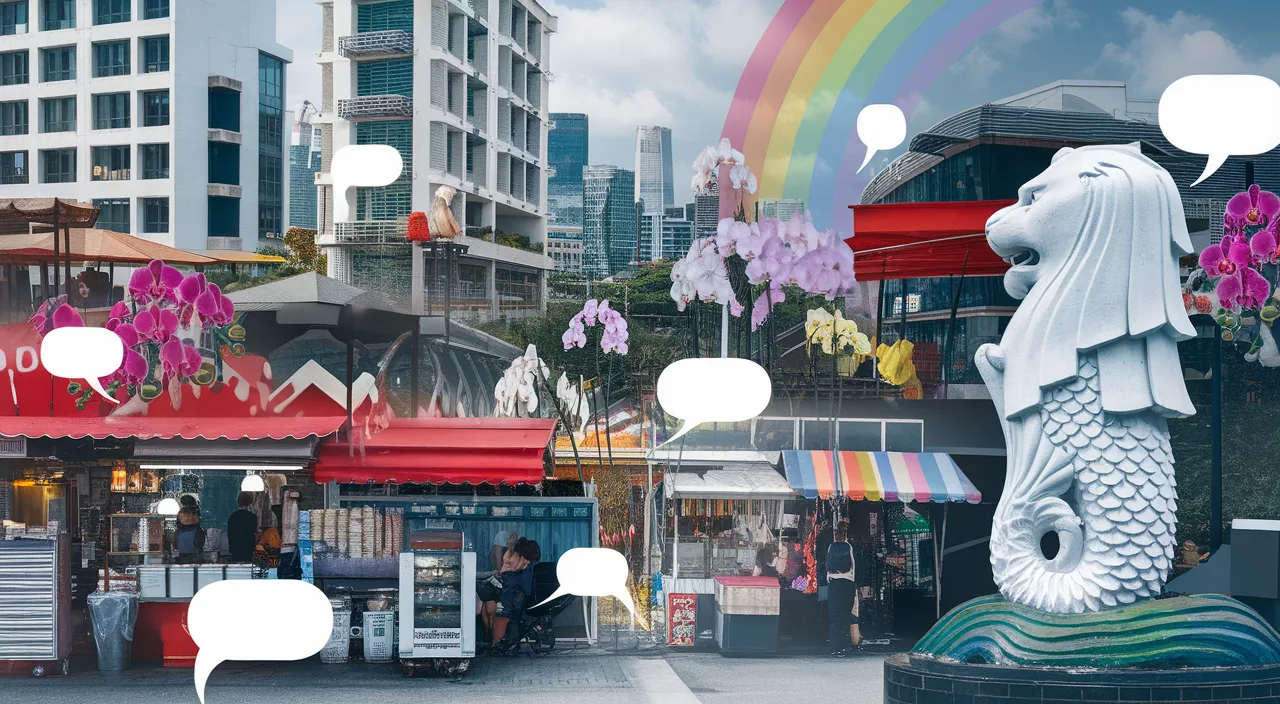
Singlish, or Singapore Colloquial English, is an informal variety of English shaped by long-term contact among the languages spoken in Singapore. It has recognisable vocabulary, grammar, rhythm and discourse particles, and it is commonly used in relaxed local conversation rather than every formal setting.
What is Singlish?
Singlish is not simply random incorrect English. It is a systematic colloquial variety that developed in Singapore’s multilingual environment. Speakers may combine English words with vocabulary and conversational patterns influenced by Malay, Hokkien, Cantonese, Mandarin, Tamil and other languages.
-

Children, Chinese, Chinese New Year, KaoBeiKing, Quote, Singlish/Hokkien, Typography
$30.00 Select options This product has multiple variants. The options may be chosen on the product page

Not every Singaporean speaks it in the same way. Usage varies by age, community, relationship and situation. Many people move between Singlish and standard English depending on their audience—a skill known as code-switching.
What makes Singlish distinctive?
Sentence-final particles
Particles such as lah, leh, lor and meh can express attitude, soften a request or show how the speaker expects the listener to interpret a sentence. They are not interchangeable decorations; changing the particle can change the social meaning.
Compact grammar
In casual speech, information understood from context may be omitted. “Can or not?” asks whether something is possible or acceptable. “Already eat?” asks whether someone has eaten. These patterns are efficient when speakers share the setting and assumptions.
Multilingual vocabulary
Singlish includes locally familiar terms for feelings, actions and social situations. KaoBeiKing’s guides explain examples such as fuyoh, cincai and don’t pray pray. Each expression performs a different conversational job.
-
hashtag, KaoBeiKing, Quote, Singlish/Hokkien, T-shirts, Typography
Price range: $30.00 through $38.00 Select options This product has multiple variants. The options may be chosen on the product page -
Chinese, Chinese New Year, KaoBeiKing, Quote, Singlish/Hokkien, T-shirts, Typography
Price range: $40.00 through $48.00 Select options This product has multiple variants. The options may be chosen on the product page

Everyday Singlish examples
- “Can lah.” — It is possible or acceptable, often with reassurance.
- “Can or not?” — Is it possible, permitted or workable?
- “Why like that?” — Why is the situation this way?
- “I catch no ball.” — I do not understand.
- “Later then do.” — Do it later rather than now.
These examples should not be copied mechanically. Intonation, relationship and context determine whether they sound friendly, impatient, doubtful or humorous.
Is Singlish the same as standard Singapore English?
No. Standard Singapore English follows internationally understood English conventions and is used in education, formal writing, public communication and many professional contexts. Singlish is the informal colloquial variety used where shared local context matters more than international accessibility.
The two can coexist. A speaker may use standard English during a client presentation, then switch to Singlish while chatting with colleagues afterward. The ability to choose the appropriate variety is more useful than treating one style as suitable everywhere.
Why Singlish matters to Singapore identity
Singapore’s SG101 account of Singlish and national identity traces its development through multilingual contact and discusses both its value and the public debate around it. The page notes that Singlish can communicate authenticity and solidarity, while also warning that it can exclude people who do not understand it.
That official account shows why Singlish is more than a list of funny words: it is a developed colloquial variety that can signal local familiarity and shared experience. The same source also supports code-switching—choosing standard English or Singlish according to context—rather than treating either variety as appropriate everywhere.
When should you avoid Singlish?
Use standard English when clarity across cultures is essential, including legal documents, safety instructions, formal reports and communication with people unfamiliar with local expressions. Singlish is not automatically rude, but assuming everyone understands it can create an unnecessary barrier.
How to learn Singlish respectfully
Listen before imitating. Notice who uses an expression, what relationship they have and how their tone changes its meaning. Learn complete situations rather than memorising isolated particles. If someone looks uncertain, switch to clear standard English instead of repeating the same phrase more loudly.
A useful starting point is the Catch No Ball meaning guide, which shows how one expression changes across lessons, meetings and casual chats.
-
Chinese, Chinese New Year, Ladies, Mens, T-shirts
Price range: $35.00 through $43.00 Select options This product has multiple variants. The options may be chosen on the product page -
Graphic, Ladies, Mens, Oversize, T-shirts, Typography
Price range: $30.00 through $38.00 Select options This product has multiple variants. The options may be chosen on the product page
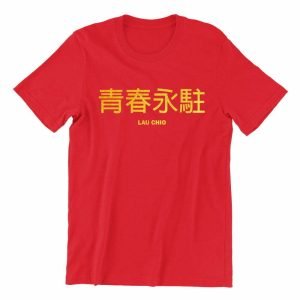

KaoBeiKing’s product search returns many items containing local expressions, but no product is named simply “Singlish.” This guide therefore avoids presenting unrelated designs as exact keyword matches.
Frequently asked questions about Singlish
What is Singlish in simple terms?
Singlish is Singapore’s informal colloquial variety of English, shaped by the country’s multilingual history and everyday speech.
Is Singlish just broken English?
No. It has recurring vocabulary, grammar and conversational patterns, although it is not appropriate for every formal or international setting.
Why do Singaporeans use Singlish?
It can communicate efficiently, express attitude and humour, and signal shared local identity in informal situations.
Should visitors use Singlish?
Visitors can learn common expressions, but should listen to context, avoid exaggerated imitation and switch to standard English whenever clarity is uncertain.