
What does “Sian” truly mean in Singlish, beyond just “bored”?
“Sian” captures a spectrum of weariness, frustration, and disillusionment far deeper than simple boredom, reflecting a unique local sensibility.
TL;DR

“Sian” in Singlish isn’t just about feeling bored; it’s a rich, versatile term expressing profound weariness, frustration, and a general sense of being fed up. It covers everything from mild annoyance to deep resignation, reflecting the mental and emotional exhaustion of daily life in Singapore. Mastering “Sian” helps you understand a key facet of local communication and emotional expression.
- Meaning: Far beyond simple boredom, “Sian” conveys a deep sense of mental or emotional exhaustion, frustration, disinterest, or a feeling of being utterly fed up with a situation or task.
- Tone: It can be delivered with a weary sigh, an exasperated groan, a mild complaint, or even a resigned acceptance, depending on the intensity of the feeling.
- Usage: Applied to situations, tasks, people, or even life in general. “So Sian,” “Sian half,” “Sian to the max” are common variations.
- Situations: Frequently heard during tedious work, long commutes, repetitive chores, endless meetings, or when facing bureaucracy and waiting times.
- Misunderstandings: Often misinterpreted by non-locals as merely “boredom.” However, “Sian” carries a much stronger emotional weight, closer to “annoyed,” “frustrated,” or “jaded.”
- Impact: It’s a powerful and relatable expression that allows Singaporeans to quickly communicate a complex emotional state, fostering shared understanding and commiseration.
Unpacking the Emotional Layers: The True Meaning of “Sian”
Ah, “Sian.” It’s a word that rolls off the tongue with a certain weight, a familiar sigh in the symphony of everyday Singaporean life. If you’ve spent any time here, you’ve undoubtedly heard it, perhaps accompanied by a slump of shoulders or a languid wave of the hand. But if you think “Sian” simply translates to “bored,” you’re missing a significant piece of the puzzle – a deep, resonant chord in the collective local psyche.
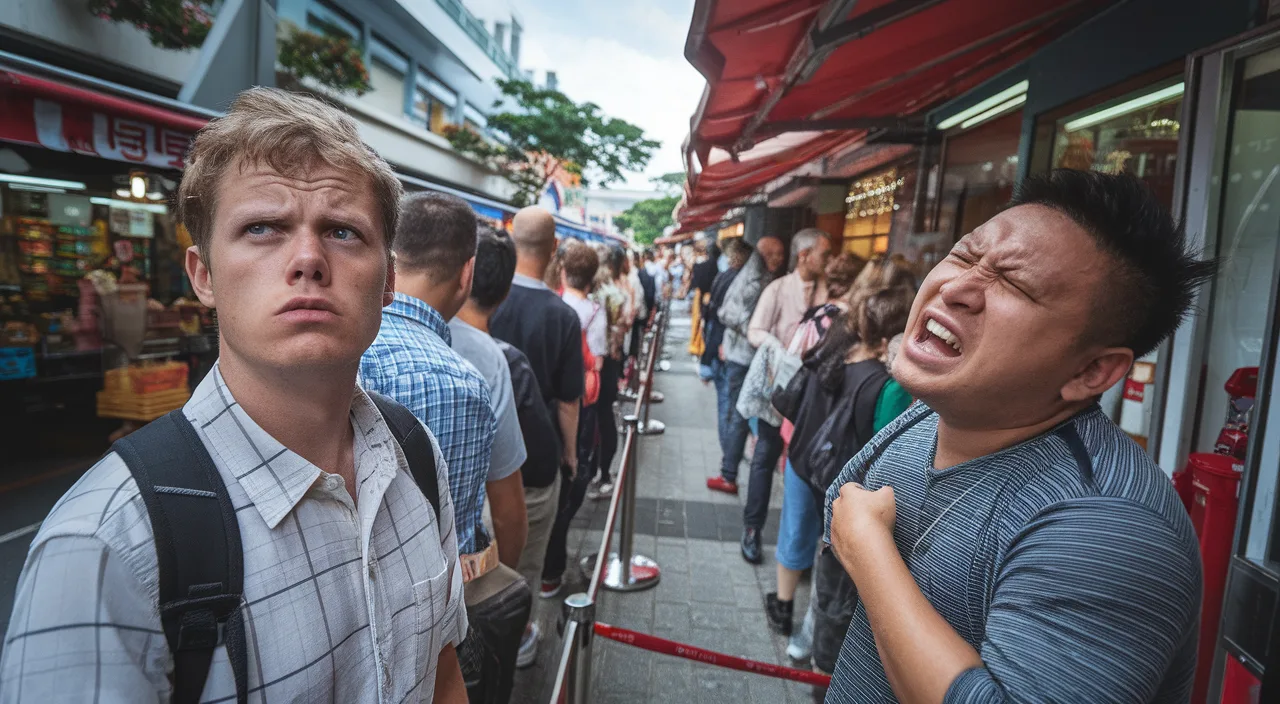
At its core, “Sian” is a feeling of profound weariness, an emotional and mental exhaustion that goes beyond mere lack of interest. Imagine standing in a perpetual queue, not just for a moment, but for what feels like an eternity. The initial boredom gives way to impatience, then frustration, and finally, a deep-seated resignation. That drawn-out feeling of being utterly fed up, of having had enough, of wishing for an end that seems perpetually out of reach – that’s “Sian.”
It’s the existential groan you emit when faced with another stack of paperwork, the sigh you heave after an hour stuck in a traffic jam on the CTE, or the quiet despair when your favourite hawker stall is closed again. “Sian” embodies a kind of emotional fatigue, a jadedness that seeps into your bones when life’s mundane, repetitive, or challenging aspects become overwhelming. It’s the feeling of watching the clock tick interminably slow during a dull lecture, wishing you were anywhere else, but accepting your fate with a weary spirit. It’s the weight of routine, the drag of obligation, and the quiet yearning for something – anything – to break the monotony.
-

Chinese, KaoBeiKing, Quote, T-shirts, Typography
Price range: $30.00 through $38.00 Select options This product has multiple variants. The options may be chosen on the product page -
KaoBeiKing, Quote, Singlish/Hokkien, T-shirts, Typography
Price range: $30.00 through $38.00 Select options This product has multiple variants. The options may be chosen on the product page

Here’s what often happens: you might hear someone say, “I’m so Sian of eating chicken rice every day.” While it sounds like boredom, it’s actually an expression of being utterly sick and tired of the repetition, a craving for novelty. It’s not that chicken rice is bad; it’s just the incessant sameness that breeds this particular brand of weariness. It’s a feeling that resonates deeply in our fast-paced, high-pressure environment, where tasks can be relentless and downtime feels scarce. The sheer volume of expectations, be it at work, in school, or even in social circles, can lead to this pervasive sense of “Sian.”
In practice, you’ll notice that “Sian” isn’t a fleeting emotion. It’s a persistent hum beneath the surface, a sentiment that gathers momentum over time. It’s the feeling of hitting a wall, not because you’re physically exhausted, but because your mental and emotional reserves have been depleted by repetitive stress or sustained disinterest. It’s the quiet frustration that builds up when things don’t go your way repeatedly, or when you’re stuck in an uninspiring situation with no easy escape. It’s a lament, a complaint, and sometimes, a shared understanding that unites us in our collective weariness.
Think of it as the emotional equivalent of a slow, draining battery. You’re not entirely flat, but you’re certainly not running at full capacity, and you’re aware of the steady decline. “Sian” is that acknowledgment of depletion, a vocalization of the desire for a change of pace, scenery, or even just a brief respite from the mundane or frustrating realities of existence.

The Expressive Tones of “Sian”: More Than Just a Word
The beauty of “Sian” lies not just in its meaning, but in the myriad ways it can be delivered. It’s a word that takes on different colours and textures depending on the speaker’s tone, body language, and the context of the situation. This versatility makes it an incredibly powerful tool for conveying a nuanced emotional state with just a single utterance.
Imagine a scenario: a friend is recounting a particularly tedious day at work. They might lean back, let out a slow, deliberate exhale, and then, with a shake of their head, utter a soft, drawn-out “Siaaaaannnn…” This isn’t just a statement; it’s a performance. The prolonged vowel, the drooping shoulders, the vacant stare – all contribute to painting a vivid picture of exhaustion and resignation. In this instance, the tone is one of weary acceptance, a quiet lament about the unavoidable grind.
Then there’s the exasperated “Sian!” This version often comes with a sharper, more abrupt delivery, perhaps a quick roll of the eyes or a frustrated flick of the wrist. This is the “Sian” you hear when someone has just missed their bus by a hair’s breadth, or when a computer system crashes right before a deadline. Here, the tone is one of acute annoyance, bordering on anger, at an inconvenience or setback. It’s a release valve for immediate, high-intensity frustration.
Consider the slightly playful, almost whining “Eh, so Sian la!” This might be heard among friends when faced with a mild, easily remedied inconvenience, like having to walk an extra block because of a road closure. The tone here is lighter, less intense, almost a performative complaint. It’s a way of eliciting sympathy or solidarity, a shared moment of minor exasperation that’s quickly forgotten.
-
Animal, Food, KaoBeiKing, Parody, Singlish/Hokkien, T-shirts
Price range: $30.00 through $38.00 Select options This product has multiple variants. The options may be chosen on the product page -


And let’s not forget the deeply melancholic “Sian…” This is often whispered, or delivered with a heavy sigh, reflecting a deeper sense of disillusionment or sadness. It’s the “Sian” you might hear when someone talks about long-term struggles, unfulfilled dreams, or the general unfairness of life. This tone carries significant emotional weight, hinting at a quiet despair or a profound sense of feeling lost. It’s not just a passing mood; it’s a heavy cloak of weary resignation that settles over the speaker.
The beauty of these tonal variations is that they allow “Sian” to be used across a broad spectrum of emotional intensity, from the trivial to the profound. It’s a linguistic shortcut that communicates a complex internal state with remarkable efficiency. When a local says “Sian,” they’re not just uttering a word; they’re inviting you into their emotional landscape, giving you a glimpse of their current struggle or weariness. Understanding these subtle shifts in tone is crucial for truly grasping the spirit of Singlish and the emotional intelligence embedded within our everyday conversations. It’s a testament to how deeply ingrained this single word is in expressing our lived experiences.
How We Use “Sian”: Navigating Everyday Singaporean Life
Now that we’ve delved into the deep emotional wellspring of “Sian,” let’s explore its practical application in the bustling tapestry of Singaporean life. This isn’t just a word for dramatic declarations; it’s seamlessly woven into the fabric of our daily interactions, a verbal shorthand for shared experiences and commiserated feelings.
In our compact city-state, where life often feels like a constant balancing act between efficiency and frustration, “Sian” becomes an indispensable tool. You’ll hear it in diverse settings, painting vivid pictures of the speaker’s state of mind. Let’s consider some common scenarios:
The Grind of Daily Commutes
Picture this: It’s peak hour. You’re sardine-packed in the MRT, inching along. The train suddenly stops between stations. A collective groan rises, and then, inevitably, someone sighs, “Aiyoh, so Sian, still stuck here!” This isn’t just about being bored; it’s about the lost time, the stifling heat, the sheer physical and mental drain of a commute that refuses to end. It’s a lament for personal space, for punctuality, and for a moment of quiet peace.
The Inevitable Workplace Woes
At the office, “Sian” is practically a staple. “Another email chain about this old problem? Sian, lor.” This is not merely finding the task uninteresting; it’s the exasperation of confronting a repetitive, unproductive, or illogical situation. It speaks to a weariness of corporate bureaucracy, endless meetings that yield little, or the Sisyphean task of dealing with a difficult client or colleague. It’s the sigh before tackling a mountain of paperwork you know will lead nowhere, or the quiet groan when a weekend plan gets cancelled due to work.
Academic Pressures and Endless Studying
For students, “Sian” is a constant companion. “This exam is so Sian, too many things to memorise.” It’s the feeling of overwhelming pressure, the mental fatigue from poring over textbooks for hours, the sheer volume of information to absorb. It captures the struggle against tedium and the yearning for the freedom that comes after submission deadlines. The relentless cycle of assignments, projects, and exams can make even the most passionate student feel profoundly “Sian.”
Social Dynamics and Obligations
Even in social settings, “Sian” finds its place. “Going for another family gathering? Sian, I just want to chill at home.” Here, it’s about the social exhaustion, the pressure to conform, or the desire for personal downtime over obligated interaction. It’s not that you dislike your family; it’s the sheer energy required for constant social engagement when you’re already feeling depleted. It speaks to the introverted soul yearning for solitude amidst a bustling social calendar.
The Waiting Game
In Singapore, waiting is an art form, and “Sian” is its soundtrack. Waiting for a table at a popular hawker centre, waiting for your turn at the polyclinic, waiting for the lift during peak hours. Each minute stretches, and the initial patience gives way to that familiar, pervasive “Sian” feeling. It’s the acknowledgement of time slipping away, the feeling of being trapped in suspended animation, unable to move forward.
The beauty of “Sian” lies in its universal applicability across these diverse situations. It’s a word that cuts across age, gender, and social strata, instantly communicating a shared sentiment. When you say “Sian,” you’re not just expressing an emotion; you’re often inviting commiseration, an unspoken understanding that others have been there too. It fosters a subtle sense of solidarity, a shared grumble that binds us together in the small, everyday challenges of life.
In practice, you’ll notice that “Sian” can be a very efficient communication tool. Instead of lengthy explanations about why one is feeling tired, bored, frustrated, or disillusioned, a simple “Sian, la” often suffices. It’s a linguistic economy, getting straight to the point of emotional exhaustion. Understanding its deployment in these contexts is key to truly speaking like a local, not just using local words, but embodying the local spirit of shared, understandable emotional states.
When “Sian” Strikes: Common Situations in the Lion City
The environment of a bustling city like Singapore, with its unique rhythm and pressures, often sets the stage for moments of “Sian.” It’s in these specific, recurring scenarios that the word truly comes alive, becoming the perfect descriptor for our collective sighs and frustrations.
The Perpetual Pursuit of Excellence
Singapore is known for its high standards and competitive spirit. From a young age, students are encouraged to excel, leading to intense academic pressure. The late nights spent cramming for exams, the endless tuition classes, the constant comparison with peers – these are fertile grounds for “Sian.” “My tuition classes are so Sian, seven days a week!” This isn’t just boredom with a subject; it’s the exhaustion of a relentless schedule, the feeling of being on a never-ending treadmill, with little time for rest or personal pursuits.
Navigating Bureaucracy and Red Tape
Despite our efficiency, there are still moments when navigating administrative processes can feel like a labyrinth. Long queues at government agencies, filling out seemingly identical forms multiple times, waiting for approvals that take forever. “Filling up all these forms is so Sian,” someone might lament. It’s the frustration of encountering inertia, the feeling of being a cog in a large, slow-moving machine, and the mental drain of repetitive, mind-numbing tasks.
The Monotony of Routine
Life in a highly structured urban environment can sometimes feel repetitive. The same commute every day, the same lunch at the same hawker stall, the predictable rhythm of work or school. While comforting for some, for others, this can lead to a pervasive sense of “Sian.” “Every day wake up, go work, come home, sleep. So Sian, what to do?” This expresses a yearning for spontaneity, adventure, or just a break from the predictable grind. It’s a weariness born from the lack of novelty, a quiet longing for something to disrupt the pattern.
The “Kiasu” Culture and Social Pressures
The “kiasu” (fear of losing out) mentality, while driving progress, can also contribute to feelings of “Sian.” The pressure to always be on top, to have the latest gadgets, to secure the best deals, to compete for limited resources. “Always must rush for everything, so Sian.” This captures the exhaustion of a society constantly striving, where even leisure can feel like a competition. It’s the fatigue of trying to keep up with the Joneses, or the mental drain of always being on guard lest you miss out on something.
Overwhelm from Information and Choices
In our hyper-connected world, we’re constantly bombarded with information, options, and demands. Deciding what to eat from an extensive food court menu, choosing a phone plan from a myriad of options, sifting through endless social media feeds. This can lead to decision fatigue, a form of “Sian.” “So many things to choose, Sian already.” It’s the mental overload, the paralysis by analysis, and the weariness that comes from having too many inputs and choices in a day.
These scenarios are more than just fleeting irritations; they are the recurring undercurrents of life that make “Sian” such a deeply relatable and frequently used expression. It’s the word that articulates that specific blend of local frustration, resignation, and a desire for a brief escape from the relentless pace and demands of urban living. When you hear “Sian” in these contexts, you’re not just hearing a complaint; you’re hearing an echo of shared experience, a moment of mutual understanding in the vibrant, sometimes overwhelming, tapestry of Singapore.
Beyond Boredom: Common Misinterpretations of “Sian”
One of the biggest hurdles for non-locals trying to grasp Singlish is the nuanced emotional landscape encapsulated by words like “Sian.” The most common, and perhaps most significant, misunderstanding is to simply equate “Sian” with “boredom.” While boredom can certainly be a component of “Sian,” it rarely captures the full depth and spectrum of emotion this versatile word conveys.
Here’s what often happens: A visitor might hear a local friend say, “Today nothing to do, so Sian,” and naturally assume they mean, “I’m bored because there’s nothing to do.” While partially true, the “Sian” in this context often implies a deeper feeling of listlessness, a lack of motivation, or even a mild sense of disappointment that the day isn’t offering anything more stimulating. It’s not just the absence of activity; it’s the weariness of that absence, or the underlying frustration with the lack of exciting options.
Consider the difference: when you say “I’m bored,” it often suggests a desire for something to happen, an emptiness to be filled. When a Singaporean says “Sian,” especially with a sigh, it can carry an undertone of resignation or feeling overwhelmed by the very idea of having to find something to do, or a general feeling of being tired of everything. It’s less about a momentary lack of stimulation and more about a pervasive sense of emotional drain or exasperation. It’s closer to feeling “fed up,” “jaded,” “weary,” or even mildly “depressed” about a situation than just plain “bored.”
In practice, you’ll notice that while “bored” is a relatively neutral feeling, “Sian” often implies a negative emotional charge. If you’re merely bored, you might shrug it off. But if you’re “Sian,” there’s usually an undercurrent of irritation, frustration, or a genuine desire for things to be different. It’s the difference between wishing for something to happen and wishing something else would happen, or even wishing that the current situation would just end.
Another common misinterpretation stems from cultural context. In many Western cultures, expressing such a pervasive sense of weariness might be seen as overly negative or a complaint. However, in Singapore, “Sian” is a perfectly acceptable, even empathetic, way to articulate one’s state. It’s a shared understanding, a collective groan that doesn’t necessarily demand a solution but often seeks commiseration. Outsiders might perceive a local saying “Sian” as complaining excessively, when in fact, it’s merely an honest and concise expression of a relatable emotional state.
Furthermore, “Sian” often implies a sense of feeling overwhelmed or jaded by repetition or perceived futility. If you’re “bored” of a task, you might just want a new one. But if you’re “Sian” of a task, it suggests a deeper exhaustion with the nature of the task itself, or the lack of meaning in its completion. It’s the difference between a child saying “I’m bored” because they have no toys, and an adult saying “Sian” because their job has become monotonous and unfulfilling, despite having many responsibilities.
Understanding this distinction is crucial for building genuine rapport. If you respond to someone saying “Sian” with a suggestion for a fun activity, you might miss the underlying emotional weight. Sometimes, what they truly need is not a distraction, but an acknowledgement of their weariness, or a moment to vent their frustration. It’s about recognizing that “Sian” is a feeling that often runs deeper than the surface-level meaning, requiring a more empathetic and contextualized response than merely offering entertainment.
So, the next time you hear “Sian,” pause and consider the context. Is it simple boredom, or is it a more profound expression of fatigue, frustration, or disillusionment? Learning to differentiate will not only improve your Singlish comprehension but also deepen your understanding of the emotional pulse of Singaporean life.
Echoes and Empathy: Variations and Responses to “Sian”
Like a well-loved song with many covers, “Sian” has its own set of variations and elicits a range of responses within the Singlish lexicon. These linguistic nuances further enrich its meaning and demonstrate its deep integration into the way Singaporeans communicate their feelings.
Variations of “Sian”
To intensify the feeling or add specific shades of meaning, Singaporeans often append modifiers to “Sian”:
- “Sian half”: This implies a milder, yet still palpable, level of weariness or frustration. It’s akin to being halfway to completely fed up. “This presentation is so Sian half, I almost fell asleep.”
- “Sian to the max”: This is the ultimate expression of “Sian,” signifying an extreme level of exasperation, exhaustion, or disillusionment. There’s no coming back from “Sian to the max.” “After working overtime all week, I’m Sian to the max, really.”
- “Sian liao”: Adding “liao” (a particle indicating completion or change) suggests that the feeling of “Sian” has fully set in or has reached a point of no return. “The traffic jam still never move, Sian liao, confirm late.”
- “Sian boh?”: Used as a question, this asks, “Are you Sian?” or “Isn’t this Sian?” It’s a way to check in with someone’s emotional state or to seek commiseration. “Another round of revisions? Sian boh?”
- “Super Sian / Very Sian”: Simple intensifiers to highlight a strong feeling of “Sian.” “My new project is super Sian, so many problems.”
These variations allow for a fine-tuning of the emotion, demonstrating the flexibility and precision with which “Sian” can be used to describe internal states.
Responses to “Sian”
When someone expresses “Sian,” the typical local response isn’t always to offer a solution. More often, it’s about acknowledging and validating the feeling, fostering a sense of shared understanding and empathy. Here are some common ways Singaporeans respond:
- Commiseration and Empathy: The most common response is often a simple “Aiyoh, I know, right?” or “Same, la, me too.” This offers immediate solidarity, letting the person know their feelings are understood and shared. It’s about collective experience, a nod to the mutual struggles of daily life.
- Offering a Respite or Distraction: “Go grab a kopi?” or “Want to go lim kopi (drink coffee) later?” Sometimes, the answer to “Sian” is a temporary escape, a moment to reset and recharge. It’s a practical, immediate relief, even if it doesn’t solve the root cause.
- A Gentle Rebuke or Encouragement: If the “Sian” seems to be leading to excessive negativity, a friend might say, “Don’t be so Sian, la, cheer up!” This isn’t dismissive but rather an attempt to nudge the person towards a more positive outlook, especially if the situation isn’t dire. It’s a gentle push from a place of care.
- Shared Laughter: Sometimes, the only way to deal with an incredibly “Sian” situation is to laugh at its absurdity. A shared chuckle can lighten the mood and create a bond over mutual exasperation. “Wah, so Sian also can. Hahaha!”
- Practical Advice (Less Common, but Possible): If the “Sian” is clearly about a solvable problem, a friend might offer, “Maybe you try asking boss for help?” or “Why not you take MC (medical leave) and rest?” This is less about the emotion itself and more about addressing the underlying cause if it’s within reach.
In practice, you’ll notice that the response largely depends on the perceived intensity and context of the “Sian.” A casual “Sian half” might elicit a lighthearted “Just tahan (endure) a bit more!”, while a profound “Sian to the max” might call for deeper empathy and a quiet presence. The beauty of these exchanges lies in their unwritten rules, a dance of understanding that strengthens social bonds and validates individual experiences.
Understanding these variations and responses is like gaining access to a secret handshake within the Singlish community. It allows you not only to express your own weariness effectively but also to respond with appropriate empathy and cultural sensitivity when others share their “Sian” moments. It’s a truly authentic way to engage with the emotional landscape of Singapore.
Final thoughts
The journey through the intricate world of “Sian” reveals a word far richer and more profound than its seemingly simple translation. It’s more than just boredom; it’s a living, breathing expression of the multifaceted weariness, frustration, and disillusionment that permeates the lived experience in a bustling city-state like Singapore. From the relentless pace of daily life to the quiet moments of existential fatigue, “Sian” serves as an invaluable linguistic tool for articulating these complex emotions.
By understanding its numerous meanings, the subtle nuances in its tone, and its widespread application across countless situations, you gain a deeper appreciation for the Singaporean spirit. “Sian” isn’t a complaint in the conventional sense; it’s a shared sigh, a collective understanding, and a powerful bond that connects individuals through their common struggles and moments of emotional depletion. It’s a testament to our ability to find solidarity in our weariness and to communicate complex feelings with remarkable efficiency.
So, the next time you hear or feel that familiar weight, that pervasive sense of being fed up, remember “Sian.” Embrace it, articulate it, and most importantly, understand it. For in this single word lies a window into the authentic heart of Singlish and the very soul of Singaporean resilience.
FAQ
- What is the simplest way to explain “Sian” to a non-local?
- The simplest explanation is that “Sian” means being “fed up,” “weary,” or “frustrated,” which covers more emotional ground than just “bored.” It’s a deeper, more pervasive sense of annoyance or exhaustion.
- Is “Sian” a negative word, or can it be used playfully?
- While it typically carries a negative connotation of weariness or frustration, “Sian” can certainly be used playfully among friends to exaggerate a minor inconvenience or to seek lighthearted commiseration. The tone of voice is key.
- Can I say “Sian” about a person?
- Yes, you can. If someone is being very annoying or tedious, you might say “This person is so Sian.” It implies that the person’s actions or presence is making you feel fed up or exasperated.
- What’s the origin of the word “Sian”?
- “Sian” is believed to be derived from the Hokkien word “suah” (嫌), meaning to be tired, disgusted, or fed up. Its integration into Singlish reflects the rich linguistic tapestry of Singapore.
- How does “Sian” differ from simply saying “tired” or “frustrated” in English?
- “Sian” often encompasses both tiredness and frustration, but with an added layer of resignation or disinterest. It’s a more holistic feeling of general emotional depletion or being fed up with a situation, often sustained over time, which isn’t fully captured by single English words.
- Is it rude to say “Sian” in formal settings?
- While it’s a very common everyday expression, it might be considered informal in highly formal settings, such as a business presentation or a meeting with dignitaries. It’s best reserved for casual conversations or when expressing genuine weariness among close colleagues or friends.
- What is a good response when someone tells you they feel “Sian”?
- A good response is often one of commiseration and empathy, like “Aiyoh, I know, right?” or “Same, la.” You could also offer a simple, practical suggestion for a break or a distraction, depending on the context and your relationship with the person.