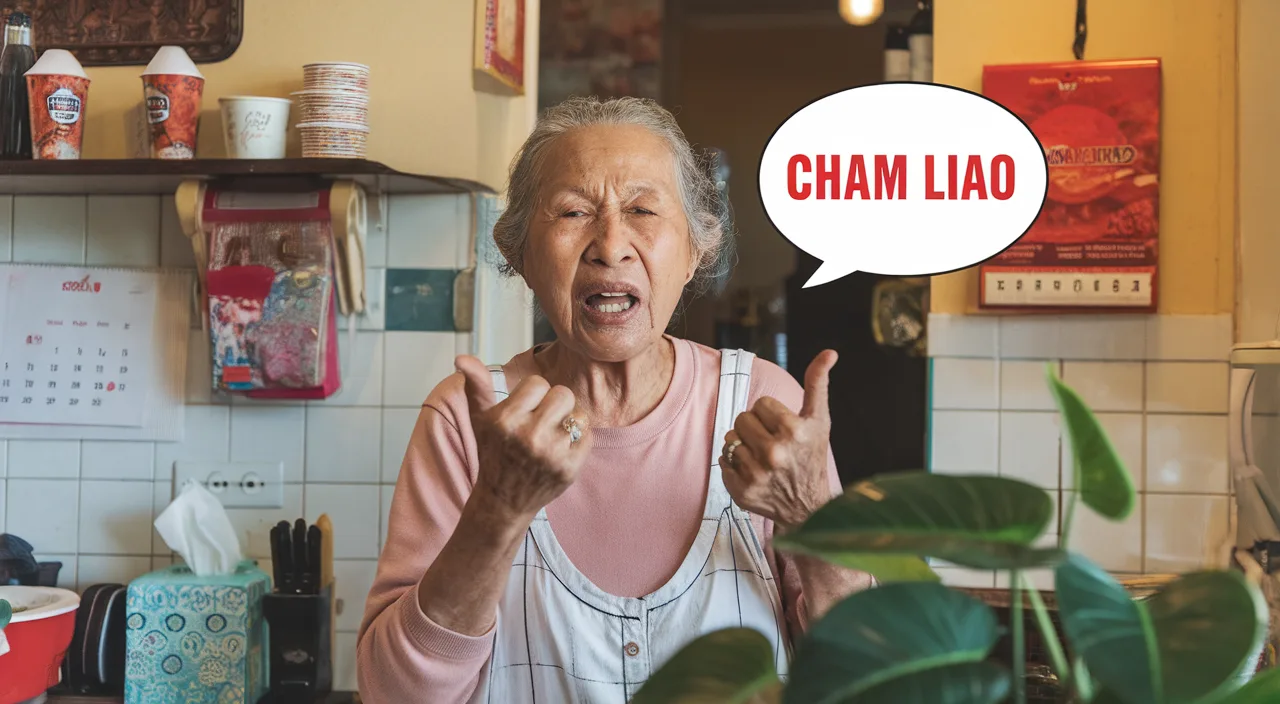
Cham liao means that a situation has become bad, troublesome or worrying—roughly “oh no, we’re in trouble now”. Singaporeans may say it after spotting a mistake, missing a deadline or realising that a plan has gone wrong. It can signal real concern or playful mock panic; the speaker’s tone and the size of the problem tell you which one.
Cham liao meaning at a glance
- Core meaning: the situation is bad now, or trouble has arrived.
- Typical emotion: worry, resignation, alarm or exaggerated comic despair.
- Register: informal Singapore English, often shaped by Hokkien.
- Severity: ranges from a small inconvenience to a serious problem.
- Formal alternative: “we have a problem” or a more specific explanation.
Where the phrase comes from
The first part, cham, corresponds to the Southern Min/Hokkien word written 慘. Taiwan’s Ministry of Education dictionary defines tshám (慘) as sad or unfortunate and also “terrible” or “bad”. Singapore spelling follows local sound and convention rather than the dictionary’s romanisation.
The second part, liao, marks completion or a new state. Linguist Zhiming Bao’s study of “already” in Singapore English explains two related aspectual meanings: completion of an action and the beginning of a new state. Cham liao uses the second idea especially clearly—the situation has now become bad.
That is why the phrase carries more movement than simply saying “cham”. It does not only label something unfortunate; it announces a turn: a moment ago things might have been manageable, but now there is trouble.
How Singaporeans use cham liao
| Situation | Natural example | Likely meaning |
|---|---|---|
| Work mistake | “Cham liao, I sent the old file to the client.” | A real problem needs fixing. |
| Missed transport | “Last train gone liao—cham liao.” | The plan has become difficult. |
| Cooking mishap | “Rice burn already. Cham liao.” | Minor domestic disaster, possibly comic. |
| Exam talk | “I left one whole question blank. Cham liao.” | The speaker fears a bad result. |
| Friendly teasing | “Your crush saw that message? Cham liao lor.” | Playful prediction of awkwardness. |
In speech, a quiet “cham liao” can sound resigned, while a loud drawn-out version creates drama. In writing, extra punctuation and emojis may push it towards comedy. None of those signals is universal, so read the relationship and situation rather than the words alone.
Cham liao, jialat and die liao
These expressions overlap, but each frames the problem differently.


- Cham liao announces that things have now become unfortunate or troublesome.
- Jialat describes something as severe, terrible or troublesome. Read our jia lat usage guide for the wider range.
- Die liao is a more dramatic, usually hyperbolic way to say “I’m doomed” or “we’re finished”.
A forgotten umbrella might earn “cham liao” when a storm starts. Sending a confidential file to the wrong recipient is genuinely jialat and calls for immediate action. Friends may shout “die liao” after a harmless social mistake for comic effect. The vocabulary is not a risk scale; the real context decides how serious the response should be.
When not to use the phrase
Cham liao can lighten a small mishap, but humour is a poor fit when someone is hurt, grieving or facing a serious loss. In emergencies, state the problem and act. At work, replace vague alarm with information: “The wrong attachment was sent; I have recalled the email and am preparing the corrected version.”
The same code-switching principle applies across Singlish. SG101’s Singlish and national identity case study describes the value of Singlish while also emphasising the ability to use Standard English in the appropriate context. Local expression and clear formal communication are complementary skills.
Related local designs for maximum “cham liao” energy
KaoBeiKing does not currently have a published product whose title exactly matches “cham liao”. The closest relevant designs use neighbouring trouble-and-doom expressions:
- #siaoliao Canvas Tote Bag turns the familiar “siao liao” reaction into a cheeky everyday carry.
- Jialat Canvas Tote Bag uses the closest widely recognised “this is bad” expression.
- Jialat Grunge Canvas Tote Bag gives the same local warning a rougher visual style.
These are contextual alternatives, not claimed matches for the exact keyword. Linking them here helps readers compare neighbouring expressions without pretending that all three phrases mean exactly the same thing.
How to respond when someone says cham liao
- Find out whether the panic is real. Ask, “What happened?”
- Name the practical problem. A missed bus and a missed deadline need different responses.
- Offer the next action. “I’ll resend it”, “let’s take a taxi” or “call the organiser now”.
- Match the tone. Joke only when the speaker is joking and nobody is being harmed.
- Switch to precise language when necessary. Clear facts beat colourful slang in a crisis.
The phrase survives because it is compact, expressive and instantly recognisable to many Singaporeans. Used naturally, it turns the exact moment a problem appears into a shared reaction: trouble is here, and everyone knows it.
Frequently asked questions
What does cham liao mean in Singlish?
Cham liao means that a situation has become bad, troublesome or worrying—roughly “oh no, we’re in trouble now” or “this is bad already”.
What does liao add to cham liao?
Liao marks completion or a change of state in Singapore English. In cham liao, it suggests that the situation has now become bad, not merely that bad things exist in general.
-

Chinese, Chinese New Year, Ladies, Mens, T-shirts
Price range: $35.00 through $43.00 Select options This product has multiple variants. The options may be chosen on the product page -
Graphic, Ladies, Mens, Oversize, T-shirts, Typography
Price range: $30.00 through $38.00 Select options This product has multiple variants. The options may be chosen on the product page

Is cham liao always serious?
No. It can describe a genuine problem, but friends also use it playfully for small mistakes, awkward moments or exaggerated mock panic. Tone and context show the severity.
Is cham liao rude?
The phrase itself is not usually a direct insult. It is informal and expressive, so it may be unsuitable for formal communication or sensitive situations.
What is the difference between cham liao and jialat?
Both can describe trouble. Cham liao presents the situation as having turned bad now, while jialat more broadly labels something as terrible, severe or troublesome.
What should I say in formal English instead?
Choose the exact meaning: “we have a problem”, “the situation has worsened”, “this may cause a delay” or “we need to correct this immediately”.